Australian Data Sovereignty in 2025: Why Local Cloud Matters
What Is Australian Data Sovereignty?
Data sovereignty is not the same as data residency. Data residency simply means your data is stored within a geographic boundary — in this case, Australia. Data sovereignty goes further: it means your data remains subject to Australian law, is inaccessible to foreign governments without legal process under Australian jurisdiction, and is operated by an entity whose parent company is not subject to foreign surveillance law.
The distinction matters enormously when choosing a cloud provider. A hyperscaler might run servers in Sydney but still be legally compelled to hand your data to a foreign government under laws like the US CLOUD Act — without notifying you. Storing data with a local Australian cloud provider removes that risk entirely.
The Privacy Act 2024 Reforms: What Changed
In late 2024, the Australian Parliament passed the Privacy and Other Legislation Amendment Act 2024 (Cth), with most provisions taking effect from 10 December 2024. This is the most significant overhaul of Australian privacy law in over a decade, and it directly affects how organisations store and transfer data in the cloud.
Key changes relevant to cloud data handling:
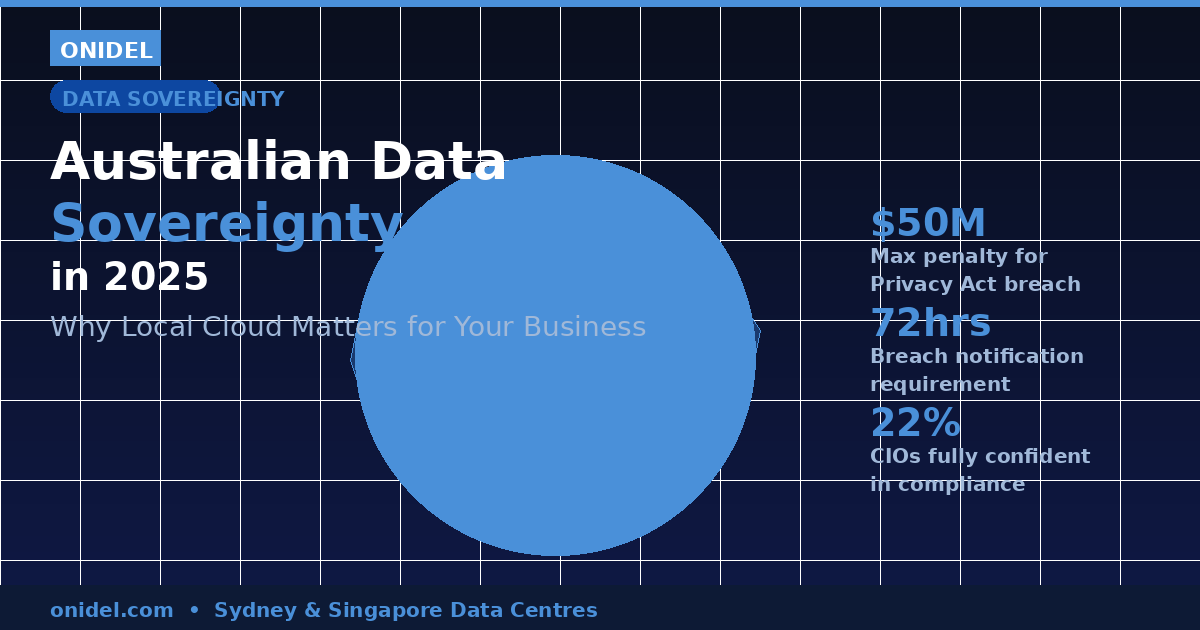
- Tiered penalties: Serious privacy interference now carries maximum penalties of $50 million, 3x benefit obtained, or 30% of annual turnover — whichever is greatest. Non-serious interference carries up to $3.3 million.
- 72-hour breach notification: Organisations must notify the Office of the Australian Information Commissioner (OAIC) within 72 hours of identifying a qualifying data breach.
- Expanded OAIC powers: The OAIC can now open investigations without a formal complaint and issue infringement notices directly.
- Overseas transfer scrutiny: The reforms introduce ministerial powers to whitelist approved countries for overseas data transfers. Transfers to non-whitelisted jurisdictions remain subject to strict accountability.
For a detailed breakdown, Norton Rose Fulbright’s analysis and Holding Redlich’s 2025 priorities guide are worth reading.
Why Offshore Cloud Creates Real Risk
Many Australian businesses still default to AWS, Azure, or Google Cloud because of brand familiarity. The risks of this choice are often underestimated:
- Foreign jurisdiction exposure: US hyperscalers are bound by the US CLOUD Act, which allows US law enforcement to compel data disclosure regardless of where the data physically resides.
- APP cross-border accountability: Under Australian Privacy Principle 8, if you transfer personal data overseas to a recipient who mishandles it, your organisation is liable — not the foreign provider.
- Sector-specific mandates: Health records under the My Health Records Act must never leave Australia. Financial services, government contractors, and critical infrastructure operators face additional restrictions.
- Confidence gap: PwC Australia’s 2025 digital trust research found only 22% of CIOs feel fully confident their cloud providers demonstrate compliance across all data sovereignty categories.
The risk profile has shifted. With $50 million maximum penalties now on the table, the cost of choosing the wrong cloud provider has become a board-level issue.
What to Look for in a Sovereign Australian Cloud Provider
Not all “Australian cloud” providers are equal. When evaluating options, check:
- Data centre location: Physical infrastructure should be in Australian data centres — not just replicated from overseas nodes.
- Corporate jurisdiction: The operating entity should be incorporated in Australia and not subject to foreign surveillance legislation through a parent company.
- Data residency guarantees: Written contractual commitment that data does not leave Australian soil without your explicit consent.
- Incident response: The provider should be able to support your 72-hour breach notification obligation with clear SLA timelines.
- S3-compatible object storage: For unstructured data — backups, media, logs, AI training sets — you need S3-compatible object storage with an Australian endpoint so your existing tools work without re-architecture.
Onidel’s Australian Infrastructure
Onidel operates data centres in Sydney and Singapore, with all Australian workloads running on Sydney infrastructure. Key offerings for data sovereignty:
- Sydney VPS (Premium): Dedicated virtual machines in Sydney — low-latency compute for applications that need to stay on-shore.
- Sydney Object Storage: S3-compatible, triple-replicated across separate storage nodes. $5/TB/month with unlimited ingress. Swap in your existing S3 endpoint for Onidel’s Sydney endpoint — no code changes needed.
- Sydney Block Storage: Persistent block volumes attached to VPS instances — suitable for database workloads requiring local residency.
All Onidel infrastructure is operated from Australia. There is no US parent company, no exposure to the CLOUD Act, and no data leaving Australian jurisdiction without your explicit direction.
Practical Steps to Assess Your Exposure
If you’re unsure whether your current cloud setup meets the new Privacy Act standards, start with these steps:
- Audit where personal data lives. Map every cloud service that touches personal information — CRM, backups, logs, analytics pipelines.
- Identify foreign-jurisdiction providers. Any service with a US, EU, or other non-Australian parent entity carries cross-border risk under APP 8.
- Check your contracts. Does your current provider have a written data residency guarantee? Can they support a 72-hour breach notification window?
- Prioritise high-sensitivity workloads. Health data, financial records, and identity information should move first to Australian sovereign infrastructure.
- Test migration friction. S3-compatible providers like Onidel make migration straightforward — a single endpoint URL change in most object storage clients.
The Bottom Line
Australian data sovereignty is no longer a “nice to have” for compliance-conscious businesses. The 2024 Privacy Act reforms created real financial exposure for organisations that cannot demonstrate where their data is, who can access it, and under which legal framework. Choosing cloud infrastructure operated within Australian jurisdiction is the most direct way to reduce that exposure.
For workloads ranging from object storage to full virtual machines, Onidel’s Sydney data centre gives you Australian-operated infrastructure with no foreign parent-company risk. Start with Sydney Object Storage from $5/TB per month — or explore Sydney VPS plans for compute workloads that need to stay on-shore.
Related Articles
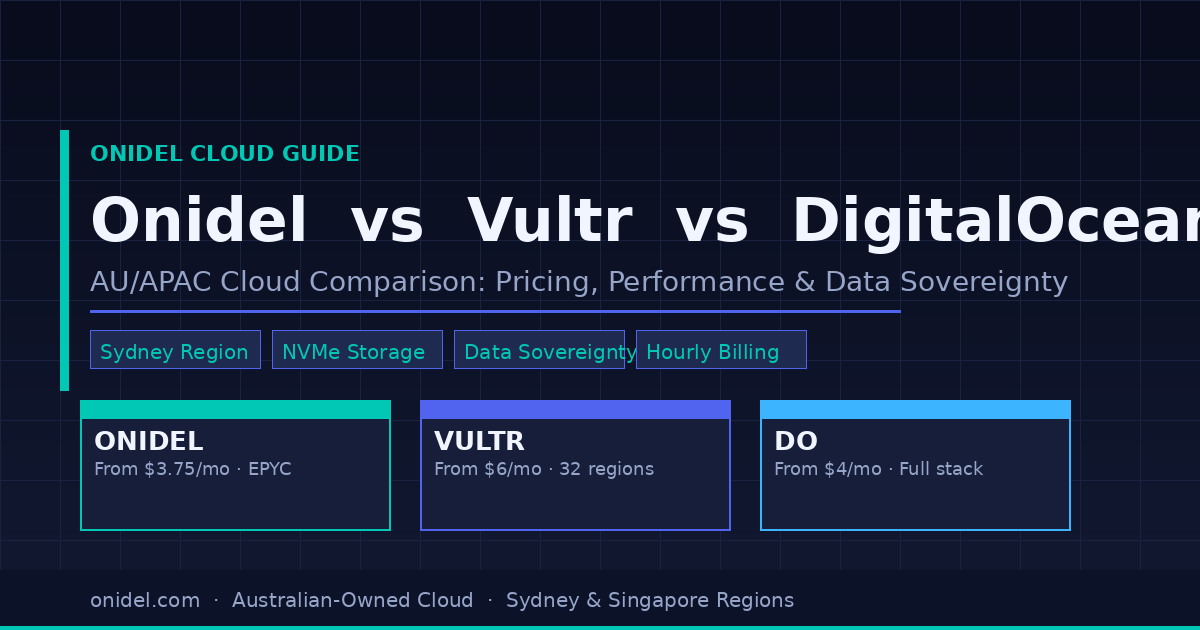
Onidel vs Vultr vs DigitalOcean: AU/APAC Cloud Comparison
Top CDN Providers for VPS in 2025: Complete Performance Analysis of Cloudflare vs Fastly vs Bunny vs Akamai