
Onidel vs Vultr vs DigitalOcean: AU/APAC Cloud Comparison
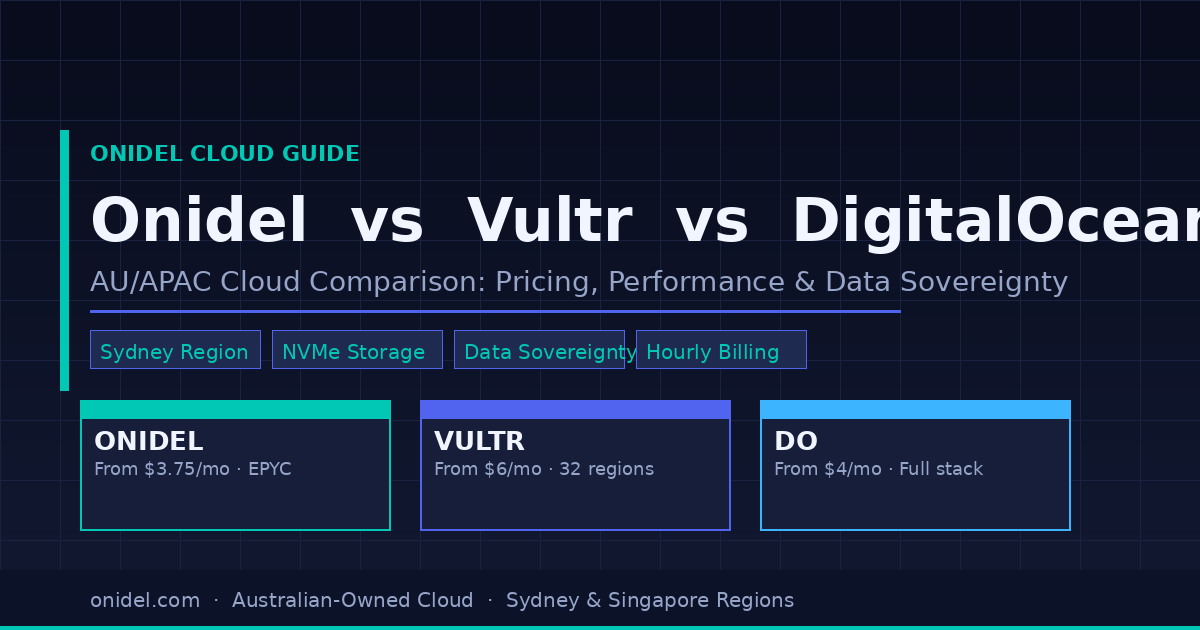
TL;DR: Onidel offers the best price-to-performance in Sydney on AMD EPYC hardware starting at $3.75/month, with full Australian ownership for data sovereignty. Vultr has broad APAC coverage and competitive entry pricing. DigitalOcean suits teams that need a managed ecosystem (Kubernetes, databases, App Platform) and can accept higher baseline costs.
Why the Provider You Choose in Australia Matters
Picking a cloud provider is not just about price per GB of RAM. For Australian and APAC businesses three factors make the comparison more nuanced than a pure spec sheet:
- Data sovereignty: Where is the company incorporated, and which legal jurisdictions can compel access to your data?
- Actual Sydney performance: Not all “Sydney” data centres are equal in terms of network peering, latency to Australian major cities, and upstream capacity.
- Total cost of ownership: Entry-level pricing is useful for comparison but egress fees, snapshot costs, and managed service add-ons often dominate real bills.
The Providers at a Glance
| Provider | Headquarters | Sydney Region | Entry VPS (Sydney) | Key differentiator |
|---|---|---|---|---|
| Onidel | Australia | Yes (native) | From $3.75/mo | AU-owned, AMD EPYC, hourly billing, S3-compatible object storage |
| Vultr | USA | Yes (SYD) | From $6/mo | 32 global regions, High Frequency compute tier, bare metal options |
| DigitalOcean | USA | Yes (SYD1) | From $4/mo | Broadest managed ecosystem (DOKS, managed DBs, App Platform) |
Pricing Comparison: Sydney VPS
Below are the closest comparable plans across each provider for compute in the Sydney region. All prices are in USD/month.
| Provider | vCPU | RAM | Storage | Bandwidth | Price/mo (USD) |
|---|---|---|---|---|---|
| Onidel (Sydney) | 2 vCPU EPYC | 4 GB | 40 GB NVMe | 2 TB @ 1 Gbps | ~$9.90 |
| Vultr (Sydney) | 2 vCPU | 4 GB | 80 GB SSD | 3 TB | $20.00 |
| DigitalOcean (SYD1) | 2 vCPU | 4 GB | 80 GB SSD | 4 TB | ~$24.00 |
| Onidel (Sydney) | 1 vCPU EPYC | 1 GB | 10 GB NVMe | 1 TB @ 1 Gbps | ~$3.75 |
| Vultr (Sydney) | 1 vCPU | 1 GB | 25 GB SSD | 1 TB | $6.00 |
| DigitalOcean (SYD1) | 1 vCPU | 1 GB | 25 GB SSD | 1 TB | $6.00 |
Prices as of March 2026. Check each provider’s pricing page for current rates: Onidel, Vultr, DigitalOcean.
Onidel’s Sydney pricing is notably competitive — roughly half the cost of comparable Vultr and DigitalOcean plans at the 4 GB RAM tier. This is partly a function of Onidel being a leaner, focused provider without the overhead of a full managed-services platform, and partly the use of AMD EPYC processors (which offer strong per-core performance relative to cost).
CPU Architecture: EPYC vs Intel vs Mixed
Onidel uses AMD EPYC Milan processors across its Sydney fleet. EPYC is a workload-optimised server CPU with high memory bandwidth and strong single-threaded performance — characteristics that matter for databases, inference, and compute-intensive applications.
Vultr offers a choice: Regular Performance instances use previous-generation Intel CPUs, while High Frequency instances use high-clock Intel Xeon processors. The High Frequency tier commands a 2–3x price premium but delivers meaningfully better single-threaded performance for latency-sensitive workloads.
DigitalOcean uses a mix of Intel and AMD hardware across its fleet, with Premium CPU Optimized droplets (starting at ~$42/month for 2 vCPU / 4 GB RAM) targeting compute-intensive workloads.
Storage: NVMe vs SSD
Onidel uses NVMe block storage across all its Sydney instances. NVMe offers 4–6x the sequential read throughput of SATA SSD and dramatically lower latency — this directly affects database performance, application boot times, and anything doing significant disk I/O.
Both Vultr and DigitalOcean’s standard plans use SSD storage (not NVMe), with NVMe available only on higher-tier plans. If raw disk performance matters for your workload, this is a real differentiator in Onidel’s favour at the entry price point.
All three providers offer supplementary block storage and object storage in Sydney. Onidel’s Sydney S3-compatible object storage is particularly relevant for Australian businesses that want to keep assets onshore without the complexity of AWS S3 or Azure Blob Storage.
Data Sovereignty: The Australian Angle
This is where the comparison diverges most significantly for compliance-sensitive Australian workloads.
Onidel is an Australian-incorporated and operated company. Your data and infrastructure are not subject to US law, the CLOUD Act, or any foreign government access framework. This is directly relevant to workloads that fall under:
- The Privacy Act 1988 and Australian Privacy Principles (particularly APP 8 on cross-border disclosure)
- My Health Records Act requirements for healthcare providers
- Government and defence-adjacent workloads requiring data residency in Australia
- Any organisation that must demonstrate data is not subject to overseas compulsory access
Vultr and DigitalOcean are both US-headquartered companies. While they operate data centres in Sydney and store data physically in Australia, they are subject to US laws including the CLOUD Act, which allows US authorities to compel disclosure of data stored on US companies’ infrastructure regardless of its physical location.
For most consumer-facing web apps and developer tooling this distinction is not material. But for healthcare records, legal documents, government data, or any workload where cross-border data access is a genuine risk, the incorporation jurisdiction of your cloud provider matters.
Ecosystem and Managed Services
This is where DigitalOcean stands apart. Its Sydney SYD1 region supports the full product catalogue: managed Kubernetes (DOKS), managed PostgreSQL/MySQL/MongoDB/Redis, App Platform (PaaS), Spaces object storage, network file storage, load balancers, and container registry. If your team wants managed infrastructure with minimal operational overhead, DigitalOcean’s ecosystem is genuinely compelling — the higher per-compute cost partially offsets the engineering time saved.
Vultr has a growing managed Kubernetes offering and managed databases, but fewer services than DigitalOcean overall. Its main advantages are the breadth of compute options (shared, high-frequency, CPU-optimised, memory-optimised, bare metal) and the 32-region global footprint, which matters if you need APAC-wide deployments beyond just Sydney.
Onidel is focused: compute (VPS), block storage, and S3-compatible object storage. It does not currently offer managed Kubernetes or managed databases. For teams building on top of raw VPS — running their own Postgres, their own Kubernetes cluster, their own caching layer — this is not a problem. For teams that want click-to-deploy managed services, DigitalOcean or Vultr may be a better fit.
Network Performance in Australia
All three providers have physical infrastructure in Sydney. DigitalOcean’s SYD1 data centre is documented to deliver a 6x reduction in round-trip latency for Australian users compared to their previous Singapore region — a meaningful improvement for latency-sensitive applications.
Onidel and Vultr also operate Sydney-native data centres. For intra-Australian latency (Sydney to Melbourne, Sydney to Brisbane), you can expect sub-15ms round-trip times from any of these three providers assuming they are in well-peered Sydney facilities.
For APAC-wide coverage beyond Australia, Vultr’s 32-region network is the strongest option, with multiple APAC points of presence. Onidel also operates in Singapore and is expanding its APAC footprint.
Billing Models
All three providers offer hourly billing, which is the baseline expectation for cloud VPS. Onidel’s hourly billing makes it straightforward to spin up ephemeral workloads — build servers, load testing environments, temporary staging instances — without committing to a monthly rate.
DigitalOcean moved to per-second billing effective January 2026 (minimum charge of 60 seconds or $0.01). This is useful for very short-lived workloads but rarely matters for typical VPS use.
Which Provider to Choose
The right answer depends on your priorities:
| Use case | Recommended provider | Reason |
|---|---|---|
| Best price in Sydney, data sovereignty required | Onidel | Lowest cost at comparable specs, Australian-incorporated, NVMe storage |
| Need managed Kubernetes, managed databases, PaaS | DigitalOcean | Broadest managed service catalogue in SYD1 |
| Multi-region APAC deployment, bare metal options | Vultr | 32 regions, High Frequency compute, bare metal in Asia-Pacific |
| AI/LLM workloads, self-hosted inference in Australia | Onidel | EPYC CPUs perform well for inference; data never leaves Australia |
| SMB wanting simple cloud with support ecosystem | DigitalOcean | Mature documentation, tutorials, and managed services reduce ops overhead |
Start with Onidel in Sydney
If you are an Australian business or developer looking for performant, cost-effective VPS hosting with genuine data sovereignty, Onidel’s Sydney region is the strongest starting point. Plans are available from $3.75/month with AMD EPYC processors, NVMe SSD storage, and hourly billing.
Onidel also offers S3-compatible object storage in Sydney and block storage to complement your compute instances — keeping your entire infrastructure stack on Australian soil.
View Onidel Sydney VPS plans and pricing →
Sources
Related Articles
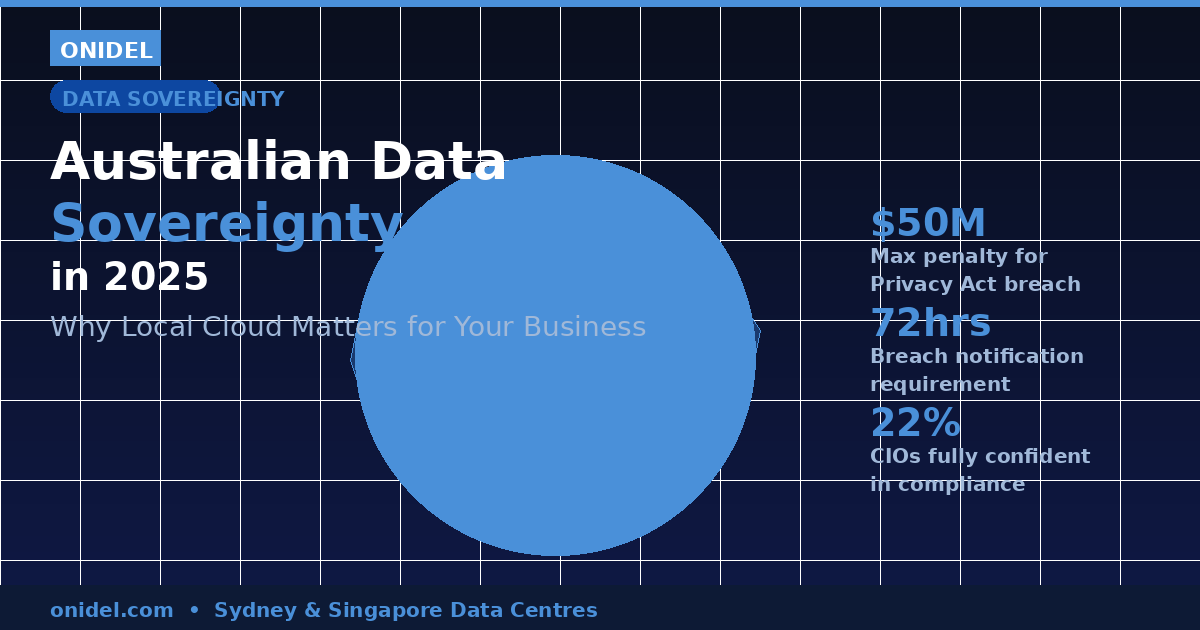
Australian Data Sovereignty in 2025: Why Local Cloud Matters
Top CDN Providers for VPS in 2025: Complete Performance Analysis of Cloudflare vs Fastly vs Bunny vs Akamai